
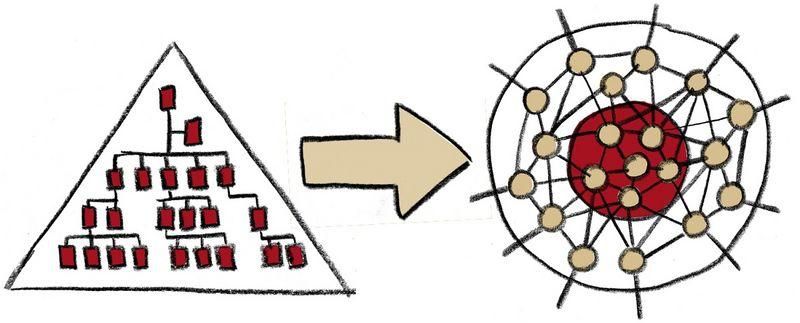
Coordination vs. Reinvention
AI is not only changing how work gets done. It is changing what management is for. Coordination-heavy management is becoming more compressible, while managers who can redesign workflows, incentives, and operating models around AI are becoming more valuable.
Most companies still treat AI adoption primarily as a technology problem — buy the licenses, deploy the copilots, roll out the platform, train the workforce, then wait for transformation.
But the data emerging in 2026 points somewhere far less comfortable: the largest predictor of meaningful AI use is not the model, the platform, or even the employee.
It is the manager.
Gallup’s 2026 State of the Global Workplace report found that manager-led AI adoption is one of the top two drivers of frequent AI use within organizations, alongside technical integration. 1 Employees whose managers actively support AI are 8.7 times more likely to report that AI has transformed how work gets done in their organization — yet only 12% of employees in AI-implementing organizations currently hold that view.
Microsoft’s 2026 Work Trend Index, drawing on 20,000 AI-using knowledge workers across 10 countries, found that organizational factors — culture, leadership behavior, workflow design, and talent practices — account for 67% of AI impact, more than double the 32% attributable to individual employee factors. 2
This creates one of the most important tensions in enterprise AI today:
AI may reduce manager headcount while simultaneously making the right managers more valuable than ever.
Most executives are still treating those as competing ideas. They are not. They are the same story.
1. The Compression of Coordination Management
For decades, organizations scaled by adding management layers because coordination was expensive. Managers collected updates, routed information, monitored execution, consolidated reporting, ran meetings, synchronized teams, and compensated for organizational friction.
AI attacks that friction directly. Copilots summarize instantly. Dashboards update automatically. AI agents coordinate workflows. Documentation becomes ambient. Search becomes conversational. Status tracking compresses.
The traditional “manager as coordinator” role is becoming economically weaker. In a podcast for MIT Sloan Management Review , ServiceNow’s Chief People and AI Enablement Officer Jacqui Canney described leadership leverage evolving dramatically as AI automates the information-routing work that historically required management layers. 3 The hard work, she emphasized, is the workflow redesign that must accompany it.
Managers experiencing the fastest structural pressure are those whose primary value has come from:
- Tracking activity and escalating issues
- Enforcing standardized processes and procedures
- Consolidating information upward through hierarchies
- Supervising coordination-heavy, stable workflows
- Managing communication overhead between functions
AI can absorb meaningful portions of this work. In many organizations, middle management layers historically existed mainly because information movement required humans. That equation is changing.
2. The Rise of Reinvention Management
While AI compresses coordination management, it simultaneously increases the value of reinvention management. The managers becoming more important are not supervisors of process. They are architects of adaptation.
Their value comes from:
- Redesigning workflows around AI capabilities
- Determining where human judgment still creates irreplaceable value
- Creating psychological safety for experimentation and failure
- Driving behavioral change rather than messaging compliance
- Translating strategy into new operational realities
- Building team capacity to continuously rethink how work gets done
AI automates execution while increasing the importance of adaptive leadership. That is the paradox most leadership teams have not fully internalized.
This paradox explains why the manager has become the critical variable in AI adoption. For the past two years, most discussion focused on employee prompting skills, AI literacy, and individual resistance. Those questions matter. But they are increasingly secondary.
Gallup’s 2026 report confirms that only 12% of employees in AI-implementing organizations strongly agree that AI has transformed how work gets done. 1 Meanwhile, Gallup CEO Jon Clifton notes that despite roughly $40 billion in enterprise AI investment, 95% of organizations have seen zero measurable profit impact, citing MIT NANDA research.
Employees are experimenting. Operating models are not changing. That gap is where managers sit.
3. Three Observable Behaviors of Reinvention Managers
Real managerial support goes far beyond approving licenses or sending encouraging messages. High-impact reinvention managers consistently demonstrate three observable behaviors:
Behavior 1: They model AI use visibly and transparently
Reinvention managers use AI in meetings, share effective prompts with their teams, discuss both successes and failures openly, and explain how AI changed specific outcomes. Teams imitate managerial behavior far more than corporate communications. When managers avoid using AI publicly, employees correctly interpret that as hidden risk.
Behavior 2: They redesign workflows instead of layering AI onto legacy processes
One of the most consistent findings in enterprise AI research is that workflow redesign — not tool deployment — is the primary driver of EBIT impact. McKinsey’s State of AI research found that AI high performers are nearly three times more likely to have fundamentally redesigned individual workflows, and that workflow redesign has one of the strongest contributions to achieving meaningful business impact of all factors tested. 4
Reinvention managers ask different operational questions:
- Which approvals can disappear entirely?
- Which meetings can be compressed, automated, or eliminated?
- What work can now be made fully autonomous?
- Where should humans concentrate judgment rather than production?
- What should customer interactions look like in an AI-native model?
Without this layer, AI simply accelerates existing inefficiencies.
Behavior 3: They actively reward reinvention
Microsoft’s 2026 Work Trend Index identified what it calls the “Transformation Paradox”: employees are ready to reshape their work with AI, but organizational systems, incentives, and norms reinforce the old ways. 2 The report found that only 13% of employees work in organizations that reward reinvention with AI, even when results fall short.
Employees optimize for what gets rewarded. If organizations continue rewarding visible effort, responsiveness, manual production, and process adherence, AI adoption will remain constrained — because employees quickly learn that using AI may improve output without improving career outcomes.
Managers control the local reward system, formally and informally. What gets praised, funded, protected, and replicated becomes the real operating model.
4. The Politics of Flattening: What the Transition Actually Requires
Executives who expect a smooth transition to dramatically flatter management structures are underestimating organizational politics. Middle managers will resist AI implementations that threaten their primary function — not because they are obstructionist, but because incentive systems built over decades reward them for it.
If a manager’s prestige, compensation, and promotion trajectory are tied to span of control — how many direct reports they have, how much budget they coordinate — they will structurally resist AI agents that shrink those empires. Bain’s February 2026 research found that organizations creating durable AI value treat AI as a “perpetual productivity engine” through linked workflow and workforce modernization, not standalone deployment. 5 Companies taking a human-centric approach to workforce productivity deliver more than two times total shareholder returns.
Three structural prerequisites tend to precede successful AI-driven management redesign:
- Compensation architecture shifts from span of control to span of impact. A manager running a three-person team augmented by AI that produces the output of a thirty-person team should be compensated accordingly.
- Succession planning explicitly targets adaptive leadership capability — workflow redesign skills, psychological safety creation, and behavioral reinforcement — rather than coordination expertise.
- Management evaluation systems shift from adoption activity metrics to verifiable business outcomes: cycle-time compression, decision velocity, quality improvements, cognitive load reduction, and measurable operating leverage.
Without realigning the political economy of the organization, middle management will act as a persistent immune response to AI transformation regardless of how sophisticated the technology deployment is.
The Gallup 2026 report confirms this dynamic: less than one-third of U.S. employees in AI-implementing organizations strongly agree that their manager actively supports their use of AI. 1 The bottleneck is structural, not attitudinal.
5. Reinvention Manager Scorecard: Replacing Activity Metrics with Outcome Metrics
Most organizations still measure AI success through activity metrics — licenses deployed, copilots enabled, chatbot usage, adoption dashboards. Those are not business metrics.
If management behavior is now the gating variable, organizations need to evaluate managers differently. The shift looks like this:
| Metric Category | Traditional Measurement | AI-Transformed Measurement |
|---|---|---|
| AI Adoption | Licenses deployed; copilots enabled | % of core workflows redesigned with AI |
| Productivity | Output volume; tasks completed | Cycle-time reduction; decision velocity |
| Team Performance | Team compliance; process adherence | Reinvention experiments launched; AI-driven quality gains |
| Managerial Value | Span of control; number of reports | Span of impact; operational leverage created |
| Customer Impact | Response time; ticket closure rate | Customer outcome improvement; cognitive load reduction |
Source: Synthesized from Bain & Company (2026) 5 and McKinsey State of AI (2025). 4
This is a fundamentally different management standard — and it is much closer to how AI actually creates enterprise value.
6. The Transformation Paradox and the Transition Challenge
Microsoft’s 2026 Work Trend Index explicitly names this tension the “Transformation Paradox”: employees are ready and willing to reinvent their work with AI, but organizational systems, incentive structures, and cultural norms continue to reinforce the old ways. 2
The numbers illustrate the gap clearly: 65% of AI users worry about falling behind if they don’t keep pace with AI, yet 45% say it feels safer to focus on existing goals than to redesign how work gets done. Only 13% work in organizations that reward reinvention.
This diagnosis points to a harder reality than most transformation programs acknowledge:
- Many current managers advanced precisely because they excelled at coordination in pre-AI environments. Adaptive leadership talent is thinner than most leadership teams assume.
- Cultural permission structures and incentive systems built over decades are notoriously sticky. Genuine operating model redesign remains rare.
- Organizations that grasp this earliest should expect some net compression of management layers alongside substantially elevated impact from those who master reinvention.
- Treating AI transformation purely as a technology deployment program will likely widen the gap between frontier firms and the rest.
Microsoft’s data also shows that manager modeling matters in quantifiable ways: when managers visibly champion AI and actively redesign workflows, teams show substantially higher AI adoption, critical thinking outcomes, trust, and readiness — compounding effects that go well beyond individual tool training. 2
7. A Practical Starting Point: Assess → Pilot → Scale
For executives ready to treat AI as a management redesign program rather than a technology initiative, a disciplined three-phase approach reduces the risk of the organizational immune response described above.
| Phase | Key Activities | Deliverables |
|---|---|---|
| Assess | Inventory management workflows; identify coordination-heavy vs. reinvention-capable roles; establish cross-functional AI Council (IT, HR, Operations, Legal/Compliance); assess manager AI literacy and current incentive structures | Workflow backlog prioritized by AI redesign potential; council charter; baseline manager evaluation criteria |
| Pilot | Select 2–3 high-impact workflows; apply redesign, not overlay; measure cycle-time compression, quality, cognitive load; identify reinvention managers; adjust local incentives; document failures as well as successes | Pilot report with before/after metrics; reinvention manager profiles; revised KPI framework for management evaluation |
| Scale | Roll out successful pilots across business lines; redesign compensation and promotion criteria organization-wide; build reinvention capability into succession planning; monitor for change fatigue and throttle pace accordingly | Organization-wide scorecard; updated talent framework; competitive moat in adaptive leadership capability |
8. The Organization Is Now the Constraint
Many executives still believe AI transformation is primarily constrained by model quality, governance, infrastructure, cybersecurity, or employee readiness. Those constraints matter. Legacy system integration and technical debt are real. In heavily regulated sectors — finance, healthcare, clinical trials — compliance requirements create genuine friction that cannot be solved through management redesign alone.
Yet the weight of evidence from Gallup, Microsoft, Bain, McKinsey, and MIT Sloan now points to a harder reality: the organization itself — specifically managerial behavior, incentive systems, workflow inertia, operating model rigidity, and cultural permission structures — has become the primary constraint. 1 2 3 4 5
McKinsey’s AI Transformation Manifesto documents that across hundreds of large-scale tech and AI transformations, the companies capturing real value concentrate their efforts on redesigning one to three business domains fully, rather than papering AI everywhere across the organization. 6 AI high performers are almost three times more likely than others to say their organization intends to use AI to bring about transformative change — and nearly three times more likely to have fundamentally redesigned individual workflows.
AI exposes management quality faster than prior technology waves because it directly intersects with how decisions, knowledge, and work move inside organizations. Management is therefore simultaneously more compressible structurally and more strategically valuable.
Your management layer may be simultaneously your largest AI bottleneck and your greatest AI advantage.
The companies that internalize this first will stop treating AI as an IT initiative. They will treat it as a management redesign program.
Conclusion
Some traditional coordination roles will disappear. Managers who can orchestrate reinvention — who redesign workflows, build psychological safety for experimentation, shift local reward systems, and translate strategy into new operational realities — will become disproportionately valuable.
That is the emerging competitive divide. Not between companies with better models or larger AI budgets. Between organizations that have figured out how to redesign management itself for an AI-native world — and those still waiting for the technology to do the organizational work for them.
Endnotes
-
Gallup. “State of the Global Workplace 2026 Report.” Gallup, April 2026. https://www.gallup.com/workplace/349484/state-of-the-global-workplace.aspx
Key findings cited: manager-led AI adoption is one of the top two drivers of frequent AI use; employees with active manager support are 8.7× more likely to say AI has transformed how work gets done; only 12% strongly agree AI has transformed their organization; fewer than one-third of U.S. employees in AI-implementing organizations strongly agree their manager actively supports their AI use. ↩ -
Microsoft. “2026 Work Trend Index Annual Report: Agents, Human Agency, and the Opportunity for Every Organization.” Microsoft WorkLab, May 2026. https://www.microsoft.com/en-us/worklab/work-trend-index/agents-human-agency-and-the-opportunity-for-every-organization
Key findings cited: organizational factors account for 67% of AI impact vs. 32% for individual factors; 13% of employees work in organizations that reward reinvention; “Transformation Paradox” framing. Survey: 20,000 knowledge workers across 10 countries, conducted with Edelman Data × Intelligence, Feb–Apr 2026. ↩ -
Canney, Jacqui. “Disintegrating the Org Chart.” Me, Myself, and AI podcast, MIT Sloan Management Review, April 2026. https://sloanreview.mit.edu/audio/disintegrating-the-org-chart-servicenows-jacqui-canney/
Key findings cited: work redesign is where leaders should spend their time; AI automation creates expansion opportunities alongside compression; successful adoption requires strong change management and workforce training, not just technology deployment. ↩ -
McKinsey & Company. “The State of AI in 2025: Agents, Innovation, and Transformation.” McKinsey & Company, November 2025. https://www.mckinsey.com/capabilities/quantumblack/our-insights/the-state-of-ai
Key findings cited: workflow redesign has one of the strongest contributions to meaningful EBIT impact; AI high performers are nearly 3× more likely to have fundamentally redesigned workflows; only about 6% of organizations qualify as AI high performers generating 5%+ EBIT impact. ↩ -
Bain & Company. “Want More Out of Your AI Investments? Think People First.” Bain & Company, February 2026. https://www.bain.com/insights/want-more-out-of-your-ai-investments-think-people-first/
Key findings cited: companies integrating workflow and workforce modernization create “perpetual productivity engines”; companies taking a human-centric approach to workforce productivity deliver 2×+ total shareholder returns; 10–15% productivity lifts translating to 10–25% EBITDA gains. ↩ -
McKinsey & Company. Singla, A., Sukharevsky, A., Smaje, K., and Lamarre, E. “The AI Transformation Manifesto: 12 Themes Driving Growth.” McKinsey & Company, April 2026. https://www.mckinsey.com/capabilities/tech-and-ai/our-insights/the-ai-transformation-manifesto
Key findings cited: AI-driven business transformations by leaders delivered average 20% EBITDA uplift and $3 return per $1 invested; successful companies concentrated on 1–3 business domains; human roles are shifting up the value stack as AI handles coordination and routine decisions. ↩
All references are based on publicly available reports and verified as of May 2026. Gallup findings reflect the 2026 State of the Global Workplace report and Q1 2026 U.S. workforce survey data. Microsoft findings reflect the 2026 Work Trend Index Annual Report. McKinsey findings reflect the State of AI 2025 report and the April 2026 AI Transformation Manifesto.